From your first line of code to your first AI app.
You type your first line of code. You press run. And instead of the friendly result you expected, your screen fills with a wall of red text you cannot read, pointing at a line number that means nothing to you yet.
Every programmer alive today has sat exactly where you are sitting right now. This book is built for that exact moment — it slows down precisely where you need it to, explains the confusion calmly, and treats your very first error message as the beginning of a skill, not proof that you don’t belong here.
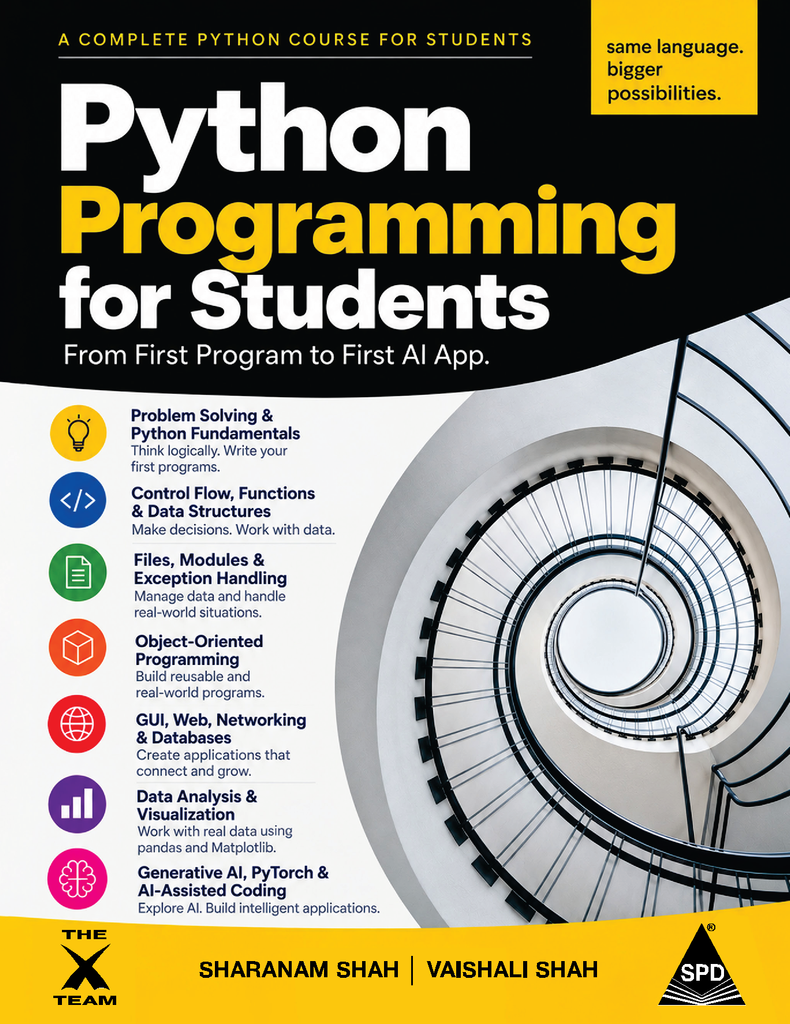
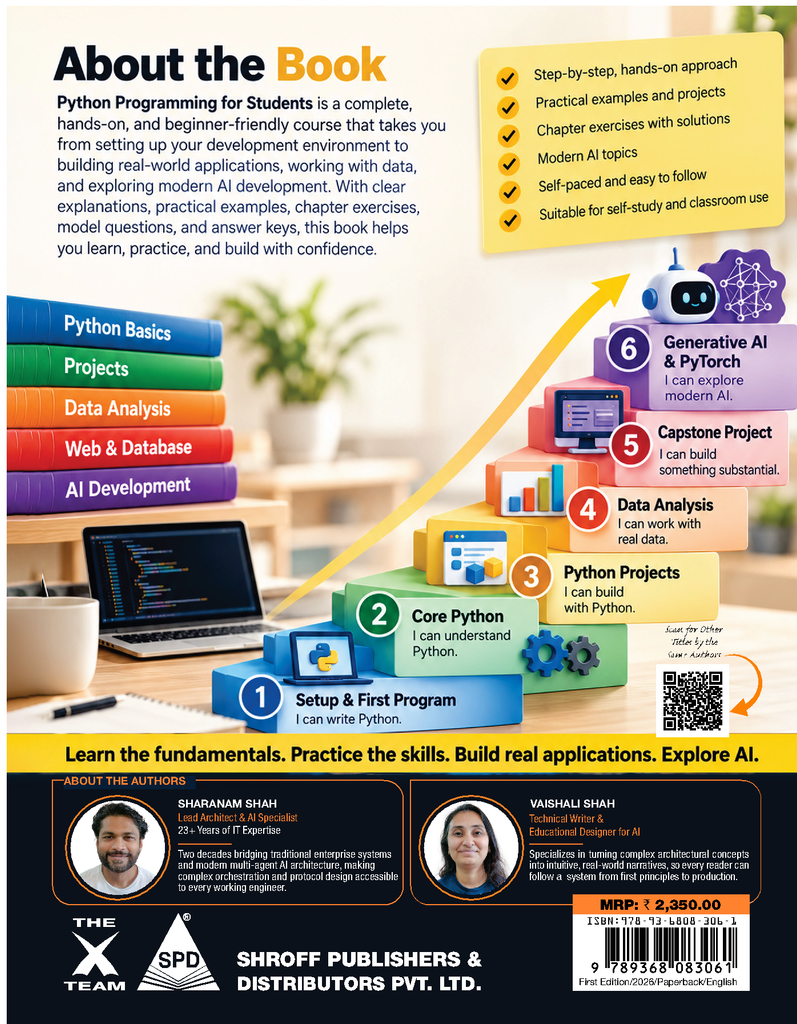
Python Programming for Students is a complete, ground-up course that starts with a single idea — an algorithm, the same kind of everyday plan you already follow to make a cup of tea — and carries that idea all the way to a program of your own that talks to a real artificial intelligence model and answers you back.
Why this book is different
Most introductory programming books make one of two mistakes. Either they read like a cold reference manual, packed with syntax nobody explains the point of — or they rush toward flashy projects and quietly skip the fundamentals a beginner actually needs for an exam, a job interview, or their very next line of code.
This book makes neither mistake. Every idea, from your first variable to your first neural network, is explained the way a patient teacher would explain it sitting right next to you — in plain language, grounded in something you already recognize from daily life, before a single unfamiliar symbol appears on the page.
Why Python, and why right now
Python is already part of your life, whether you’ve noticed it or not — quietly running behind the app that recommends your next video, the chatbot that answers a question at 2 a.m., and the tool that catches an unusual transaction on a bank statement before a human ever looks at it.
It’s also, by a wide margin, the language the entire AI industry has standardized on. Learning Python today isn’t just learning a programming language — it’s learning the specific language the next decade of technology is being written in. That’s why every unit in this book closes with a short Bridge to AI note, connecting what you just learned to the exact shape that same idea takes inside a real AI system.
What you’ll actually build
This book doesn’t ask you to trust that you’re learning something useful — it proves it, chapter after chapter, with a real, complete, working program you build with your own hands:
- The Towers of Hanoi Visualizer — your first working program, built the moment recursion stops feeling like a magic trick
- The Unit Converter — a real menu-driven tool, built the same week you meet variables and operators
- The Password Strength Checker — built while learning strings, the same skill behind every login form you’ve used
- The Student Grade Manager — a genuine record-keeping app, later reused as a real dataset you analyze with pandas
- The Personal Expense Tracker and the Library Management System — your first programs that remember something after you close them, and your first real object-oriented systems
- The Contact Book GUI and the Campus Directory API — a real desktop window with buttons you click, and a program that talks to the internet and a local database
- The Campus Management System — your capstone project, a complete, multi-stage system proving you can build something real from scratch
- The Study Buddy, the Class Performance Dashboard, and the Study Hours Predictor — three AI applications where you call a real AI model, analyze a real dataset, and train and save your own first neural network
By the final page, you won’t just have read about Python — you’ll have a small portfolio of real, working programs behind you.
How this book is organized
Thirty-two chapters, spanning an orientation chapter, a five-unit core syllabus, a three-unit extended syllabus, a capstone project, four chapters on Python and AI, and a closing unit on project environments and study resources — one continuous, carefully paced journey where every chapter hands the next one something real to build on.
| Unit | What it covers | What you build |
|---|---|---|
| I | Computational thinking and problem solving | Algorithmic thinking, recursion, the Towers of Hanoi Visualizer |
| II | Data types, expressions, statements | Python and VS Code from scratch, variables, operators, the Unit Converter |
| III | Control flow, functions, strings | Conditionals, loops, functions, recursion, the Password Strength Checker |
| IV | Lists, tuples, dictionaries | Every core data structure, and the Student Grade Manager |
| V | Files, exceptions, modules | Persistence, error handling, and the Personal Expense Tracker |
| VI | Object-oriented programming | Classes, inheritance, operator overloading, the Library Management System |
| VII | Regex, threading, GUI, web | Pattern matching, concurrency, Tkinter, and the Contact Book GUI |
| VIII | Networking and databases | Sockets, APIs, SQLite, and the Campus Directory API |
| Capstone | The Campus Management System | A complete, multi-stage system — console first, then a full GUI upgrade |
| Python and AI (4 chapters) | Gemini, pandas, PyTorch, and AI-assisted coding | |
| Resources | Virtual environments and back-of-book study material | A clean, reusable project setup, plus a consolidated question bank and two model question papers |
What you’ll walk away knowing
| Skill | What it means in practice |
|---|---|
| Computational thinking | Break a real problem into steps before you ever open an editor |
| Core Python fluency | Read and write control flow, functions, and every core data structure with confidence |
| Object-oriented design | Model a real-world system as classes, objects, and clean, reusable relationships |
| Practical file and error handling | Build programs that save real data and fail gracefully instead of crashing |
| Exam and interview readiness | Answer both a theory question and a live coding question on the same topic |
| Practical AI literacy | Call a real AI API, analyze a real dataset, and train and reuse a real neural network |
Built for serious study, ready for the real world
Every single chapter is built to double as complete, exam-ready study material:
- Multiple choice questions — 8 to 10 per chapter, written in real exam-paper style
- Theory questions by cognitive level — from recall through explanation, application, analysis, and evaluation
- Practical/lab exercises — 3 to 5 per chapter, ready to assign and complete independently in VS Code
- A complete answer key after every chapter — reasoned answers for every question, full working code for every lab exercise
- A consolidated question bank and two full model question papers at the back of the book for final revision
Who this book is for
- Complete beginners with no programming background at all
- Students preparing for a Python or programming course or exam
- Self-taught learners and career switchers who want to build real, working programs
- Anyone curious about AI who wants to understand what’s actually happening underneath a chatbot or AI coding tool
- Instructors and mentors looking for a single text with a full bank of exercises and answers already built in
You don’t need any prior programming experience or a computer science background — just a laptop, patience, and the willingness to actually build things.
Your toolkit
Every tool in this book is free, current, and exactly what you’ll keep using long after you finish the last chapter: Python 3.14.7, Visual Studio Code, a free Gemini API key, pandas and Matplotlib, and PyTorch.